
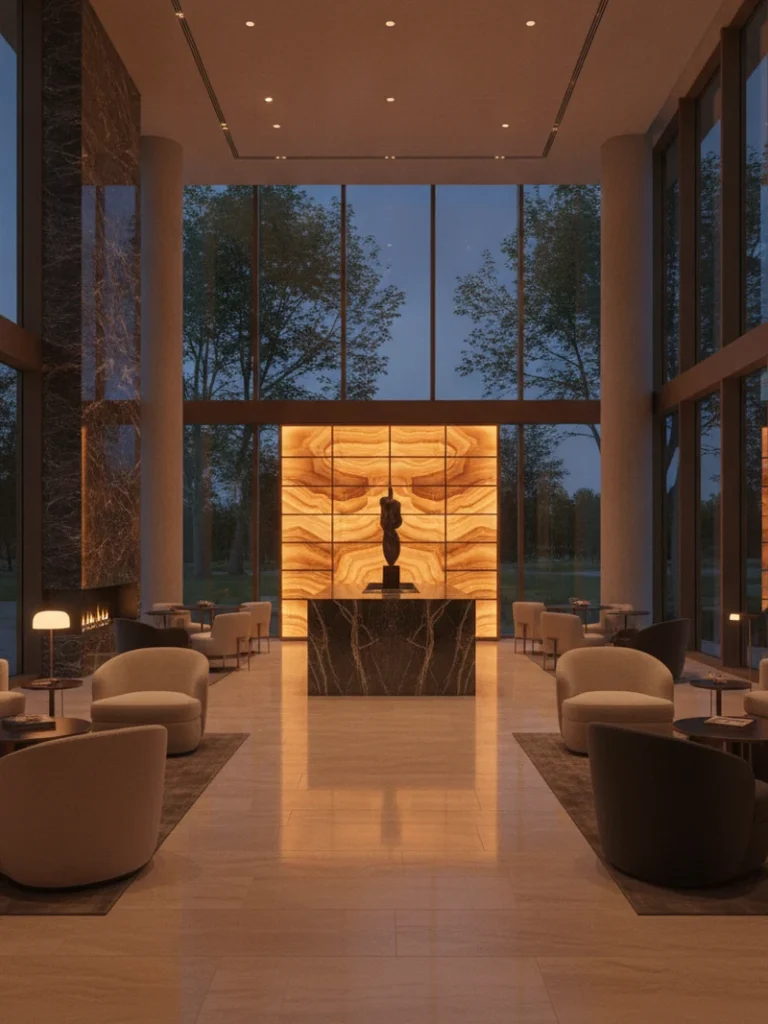
Nobody publishes their prices. Designers hide behind “it depends,” homeowners guess, and both sides waste a discovery call finding out they were never in the same universe. In this first episode, Coco Jelassi breaks the industry habit and says the numbers out loud.
Full transcript
I want to start this podcast with the thing nobody in my industry will say out loud.
Here is what interior design costs.
Not “it depends.” Not “every project is unique.” Actual numbers. Because I have sat across from too many people in Oakville and Burlington and Toronto who spent three weeks working up the courage to make a phone call, and the whole time they were terrified of one thing — that they were about to be quoted something with an extra zero on the end and have to sit there and pretend they were considering it.
So let’s take that off the table in the first ten minutes of the first episode.
I’m Coco Jelassi. I’m the principal designer at Coco Interiors, a boutique studio in Oakville. This is Designed With Intention, and this episode is about money.
First, why nobody publishes prices.
There are two reasons. One is legitimate and one is not.
The legitimate reason is that a four hundred square foot condo and a nine thousand square foot house in King City genuinely are not the same job, and a single number on a website would be meaningless for at least one of them.
The reason that is not legitimate is that vagueness is profitable. If you don’t know what something costs, you can’t compare it to anything. And if you can’t compare it, the designer sets the anchor in the room, in person, after you have already fallen a little bit in love with what they showed you.
I don’t want to work that way. Partly because it feels bad. And partly because it wastes my time too. I would much rather you read a number, decide it’s not for you, and never call me — than have both of us spend a month getting to a no.
So here is how designers charge. There are three models, and the model matters more than the number.
The first is hourly. You pay for the designer’s time, usually somewhere between a hundred and two hundred and fifty dollars an hour in this market. It sounds fair. It sounds like a lawyer or an accountant. Here is the problem — you have just signed a contract where the person doing the work makes more money the longer the work takes. Nobody is being dishonest. But every revision, every showroom visit, every “let me look at three more options” now has a meter running, and you start editing yourself. You stop asking questions because questions cost money. That’s a terrible way to design a home.
The second is cost-plus. The designer buys your furniture at trade pricing and adds a markup, usually somewhere in the range of twenty to forty percent. Sometimes the design work is close to free, because the money is made on the sourcing. And again — no dishonesty required — but the person choosing your sofa now earns more if you choose the expensive sofa. You will never be able to fully un-know that.
The third is a flat fee. One number, agreed before anything starts, for a defined scope of work. That’s what we do at Coco Interiors, and I’ll tell you exactly why. It’s the only one of the three where my incentive and yours point in the same direction. I get paid the same whether your project takes me eight meetings or twelve, and the same whether you pick the four thousand dollar dining table or the eleven hundred dollar one. Which means when I tell you the cheaper one is better in that room, you can actually believe me.
So. The numbers.
A single room — a living room, a primary bedroom, a proper redesign rather than a refresh — starts around twenty-five hundred dollars. That’s the design fee. Concept, layout, palette, sourcing, the full specification of what goes in the room and where.
A full home — main floor, bedrooms, the whole story of the house — starts around fifteen thousand. Bigger and more complex projects go up from there, and I’ll tell you where you land before you commit to anything.
And then there’s the Condo Design Package, which is a flat twenty-nine fifty and delivered in four weeks. That one exists because condos are the most common project in the GTA and the most badly served. Somebody buys a fifteen hundred square foot unit in Yorkville or Port Credit and can’t get a designer to return their call, because the industry has decided condos are too small to be interesting. They’re not. They’re just harder — you have concrete you can’t move, a window wall you can’t change, and one shot at getting the layout right. Four weeks, fixed price, done.
Now here’s the part I need you to hear, because this is where most of the confusion lives.
The design fee is not the project budget.
The design fee pays for the design. The furnishings, the millwork, the trades, the paint, the lighting — that’s a separate budget, and it’s yours. You control it. You approve every line of it.
Here’s the rule of thumb I give people. Whatever the design fee is, expect your furnishings budget to be several times that for a room done properly. A living room designed for twenty-five hundred is usually furnished somewhere between fifteen and forty thousand, depending entirely on what you already own and how you like to live.
And I say “how you like to live” deliberately. Because if you have a golden retriever and two kids under six, I am not putting a bouclé sofa in your family room. Not because you can’t afford it — because it will be ruined by March and you will resent the room and eventually you’ll resent me.
Which brings me to the mistake. The single most expensive mistake I see, and it has nothing to do with picking the wrong colour.
It’s hiring the designer too late.
People renovate first and decorate second. They finish the construction — the walls are up, the plumbing is set, the electrical is done — and then they call a designer to make it pretty. And what happens is I walk in and the kitchen island is thirty centimetres too far from the sink, there’s no outlet where the lamp obviously needs to go, and there is a beautiful window that a bulkhead now cuts in half.
None of that is fixable with furniture. All of it was fixable with a drawing, four months earlier, for a fraction of what it would now cost to undo.
Design is not the icing. It’s the recipe. If you are planning to move a wall, touch the plumbing, or change a kitchen — talk to a designer before the trades quote it, not after.
Okay. Last thing, and this one is practical.
Four questions to ask any designer before you sign. Not just me. Any of us.
One. Is this a flat fee, hourly, or cost-plus? If they can’t answer that in one sentence, that’s your answer.
Two. What exactly is included, and what triggers an additional charge? Get the boundary in writing. A good designer will already have it written down.
Three. Do you make money on the furniture I buy? Just ask it plainly. Watch what happens.
And four. What does your process look like week to week? Because “we’ll be in touch” is not a process. You should know when you’ll hear from someone and what you’ll be looking at when you do.
If you ask those four questions and you get four clear answers, you’re probably in good hands regardless of who you’re sitting with.
So that’s the money conversation. No mystery, no dance.
If you want to talk about your space — I offer a free fifteen minute discovery call. Fifteen minutes, genuinely no pressure. You tell me about the room or the house, I tell you honestly what it would cost, roughly how long it would take, and whether we’re even the right fit. And if we’re not, I’ll say so and point you somewhere better. That happens, and it’s fine.
You can book that at cocointeriors dot c-a, or call the studio directly at 2 8 9. 2 5 9. 2 7 5 0.
Next episode, I’m going to walk through the Condo Design Package week by week — what actually happens in each of those four weeks, and what you have on your wall at the end of it.
I’m Coco Jelassi. Thanks for listening.
The home is not just where you live. It’s how you live.